Propeller Slip
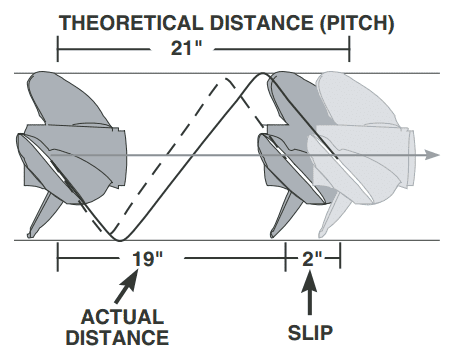
Calculate Propeller Slip: RPM div by GEAR RATIO x PITCH div by 1056 = Theoretical Speed. Then you divide the customers actual (gps) speed by the Theoretical speed to get propeller efficiency. For Example: 5500 div by 2.07 x 20 div by 1056 = 50.23mph. If customer speed is 44.00mph the propeller efficiency is 87.59% or 12.41% propeller slip.
Pitch Selection: customer is under reving (5000 rpms) with a 19 pitch prop on a 4/stroke motor, short 1000 rpms from achieving 6000 rpms. Divide 5000 by 6000 and you get 83.33% or 17% short of wide open throttle range at 6000. Decrease your current pitch prop (19) by 17% and you get a 15.80 pitch prop to achieve 6000 rpms. So that translates into a 16 pitch prop of the same style and manufacture.
A general rule: one-inch pitch change equates to about 150 to 200 RPM change. This rule is pretty solid when applied to the same blade style by the same manufacture.
A general rule: 1/4 inch of diameter change equates to about 150 to 200 RPM change.
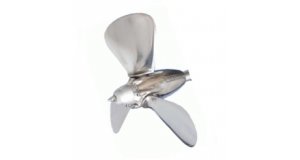
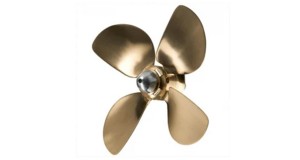
Boats with a tunnel generally (i.e. bay & flats style boats) perform better with a 4-blade prop due to the disturbed water flowing to the foot of the motor.
To convert Knots to MPH: KNOTS x 1.15 = MPH
V-bottom heavy offshore boats (3000lbs and up) need diameter (more blade surface) to perform at their best with a 4-blade being the best overall. (The OFS4R blade style)
Flat bottom boats (Jon boats & flats boats) need a stern lifting propeller. (The SCB, SCD or SCE blade style)
High performance bass boat like the TRO4R, VMX or VMS blade style.
High performance boats (Donzi, Baja, etc) like the OFX blade style.
Pontoon/barge style boats like the WBA, WBH or the WBB blade style.
Stern drive boats like the MQS & OFS blade style.